.png)
Your Organisation Has a Nervous System. Most Leaders Manage Only the Skeleton.


Many improvement programs fail because they start with the wrong metaphor. They treat the organisation as a machine. If the organisation is not a machine, what is it?
I argue it is a cognitive system because it senses, interprets, remembers, reacts, and learns. It avoids pain, copies what is rewarded, develops reflexes, and protects itself from threats. It moves faster when signals are clear and slows down when the nervous system is overloaded.
This is why some organisations feel sharp, alert, and adaptive, while others feel slow, numb, defensive, and strangely unable to act on what everyone already knows. The difference is not always the strategy. It is cognition.
The Problem: Leaders Can See the Organisation Chart, But Not the Organisational Brain
Most leaders are trained to see the visible organisation: the structure, roles, reporting lines, systems, processes, governance forums, and performance metrics. These are important. But they are not the whole organisation. They are closer to the skeleton: useful for holding things together.
But skeletons do not think, sense customers, notice weak signals, interpret risk, decide what to do, learn from failure, or build trust.
The real organisation lives in the connections between people, decisions, signals, routines, incentives, memories, and conversations. That is the cognitive system. And it is often the part of the organisation that leaders improve last, if they improve it at all.
At CoEcosystem, we do not ignore the mechanics of improvement. We help organisations build visible mechanisms grounded in cognitive, social, and adaptive patterns that shape how work actually happens. Learn more at CoEcosystem’s website.
A Better Framework: The Cognitive System Lens
“Can the organisation think clearly enough to improve?
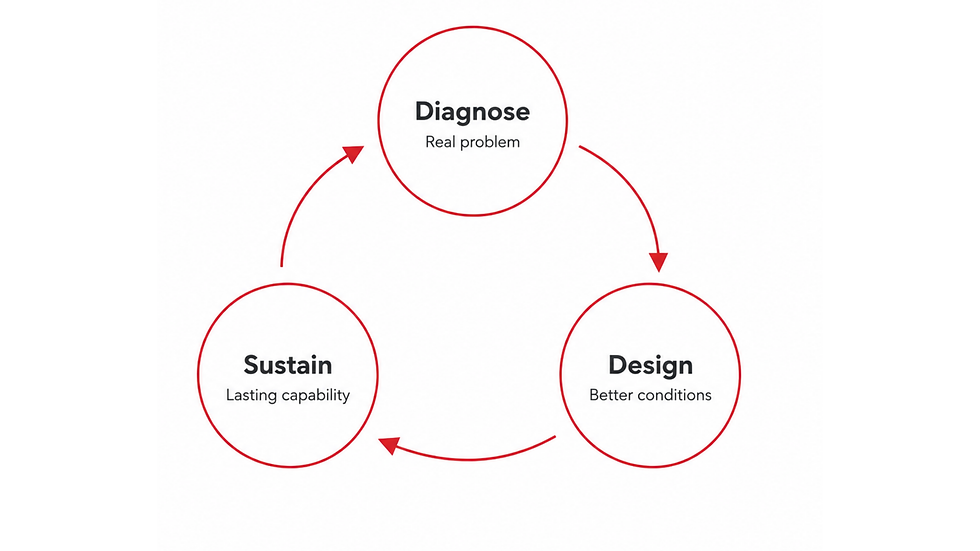
That requires looking at three things: signals, connections, and adaptation.
1. Signals: What Does the Organisation Notice?
Every organisation is surrounded by signals: Customer frustration, employee workarounds, rising rework, slow approvals, repeated exceptions, quality issues, technology friction, informal complaints, quiet disengagement, and frontline warnings, to name a few.
Signals always exist. The question is whether the organisation can notice them before they become expensive.
A healthy cognitive system has good sensory capability. It can detect weak signals early and does not need a crisis, an audit, or a public failure to pay attention. An unhealthy cognitive system is strangely numb. It receives signals, but they do not travel. People see problems locally, but the organisation does not learn globally.
The frontline, the customer, and the middle manager know, and the data suggests as much. But the system does not respond. This is not because people are unintelligent. It is because the organisation’s sensory pathways are blocked.
Sometimes the signal is buried in too much reporting, softened as it moves upward, made politically safer, or dismissed because it comes from the wrong level. So, the organisation becomes like a person who keeps touching a hot stove but has lost feeling in their fingers.
2. Connections: How Does Intelligence Travel?
In the brain, intelligence does not sit inside one neuron. It emerges through connections. The same is true in organisations. Intelligence does not sit only with the executive team, the strategy office, in dashboards, steering committees, or transformation teams.
It emerges when the right people, with the right information, can make sense of the right problem at the right time. This is why silos cause cognitive damage.
A silo is not just a structural boundary. It is a broken neural pathway that prevents information, context, and learning from travelling to where they are needed. One team sees the customer pain. Another team owns the system. Another team controls the policy. Another team carries the risk. Another team measures the outcome.
Everyone owns a fragment. Nobody owns the meaning. This is how organisations become simultaneously busy and stupid. Because the connections are poor.
A cognitive organisation does not simply ask, “Who is accountable?” It asks: Who needs to sense, interpret, act on, and learn from it? Who needs to stop creating the condition that causes it?
That is a different, and usually better, conversation.
3. Adaptation: What Does the Organisation Learn to Repeat?
The most revealing thing about any organisation is not what it says it values. It is what it repeatedly produces.
If it repeatedly produces escalation, it has learned that decisions are unsafe.
If it repeatedly produces rework, it has learned to tolerate unclear inputs.
If it repeatedly produces workarounds, it has learned that the official process does not match reality.
If it repeatedly produces defensive reporting, it has learned that data is used for judgment rather than learning.
If it repeatedly produces slow approvals, it has learned that delay is safer than ownership.
This is where the cognitive system becomes visible. Behaviour is organisational memory in action. Every repeated behaviour tells you something about what the system has learned. And this is where leaders often get adaptation wrong.
They see a workaround and call it non-compliance. Sometimes it is. But sometimes it is local intelligence. They see resistance and call it attitude. Sometimes it is. But sometimes it is risk detection. They see inconsistency and call it variation. Sometimes it is. But sometimes it is the system adapting to complexity faster than the official process can keep up.
The challenge is to know the difference. A machine view tries to remove variation. A cognitive view seeks to understand what the variation tells us. Some variation is the organisation's thinking.

The Cognitive System Lens: improvement starts by strengthening how the organisation senses signals, connects intelligence, and adapts what it learns.
A machine organisation asks: Where is the broken process?
A cognitive organisation asks: What is the system sensing, how is intelligence travelling, and what has the organisation learned to repeat? This is the next step in the metaphor shift. The first shift is away from the machine. The second shift is toward the organisation as a sensing, thinking, learning system.
A Practical Example: The Customer Complaint That Everyone Already Knew About
Imagine a service organisation receiving repeated customer complaints about delays. The reports show the issue. The frontline has been talking about it for months. Team leaders have raised it informally. Customers are frustrated.
Everyone agrees the experience is poor. So, the organisation responds by forming a working group. A process review begins, and a new slide deck is created. A senior leader asks for weekly updates. And everyone takes comfort in the old saying: “If you can’t measure it, you can’t manage it.” Well, that is true, but it is an incomplete story.
On paper, the organisation is acting. But nothing changes. The machine diagnosis says, “The process is inefficient.” That may be true. But the cognitive diagnosis asks a more interesting question: “If everyone already knew, why did the organisation not act earlier?”
That question changes the problem. Perhaps the signal existed but had no pathway to decision-makers. Perhaps the frontline had insight but no authority. Perhaps managers had authority but no confidence to challenge the policy. Perhaps the dashboard measured the delay but not the decision points that caused it. Perhaps the issue crossed three functions, so each team optimised its part while the customer experienced the whole failure.
The real issue is the organisation’s inability to convert knowledge into action. That is a cognitive failure: a failure of sensing, connection, and adaptation.
The solution is therefore not simply to redesign the process in a traditional way. It may involve creating a direct signal pathway from frontline insight to decision-making, clarifying cross-functional ownership, changing what is measured, giving teams authority within boundaries, and creating a learning rhythm where repeated complaints trigger redesign rather than reporting.
This approach improves the organisation’s ability to think.
The Real Shift
The old machine model is no longer enough. Organisations in the knowledge economy are cognitive systems.
Neural, because intelligence depends on the quality of connections.
Social, because behaviour is shaped by trust, status, belonging, and fear.
Adaptive, because the organisation is constantly learning what to repeat, avoid, escalate, hide, or improve.
The real constraint in modern organisations is rarely effort. People are often working too hard. The constraint is not always information. There is usually plenty of information. The constraint is not always technology. Many organisations have more technology than clarity.
The real constraint is the organisation’s ability to sense what matters, connect intelligence across boundaries, and adapt behaviour faster than the environment changes. That is why improvement must become more cognitive. Not softer. More precise.
We must understand how truth travels, where signals get distorted, which connections are weak, and where the organisation has learned the wrong reflex. We must understand which behaviours keep recurring and where people are using intelligence outside the formal process because it is too slow, too rigid, or too disconnected from reality. This understanding explains why the strategy does not land, dashboards do not change decisions, processes are bypassed, technology is effective, and lessons are repeatedly “learned” but not retained.
A machine can be repaired. A cognitive system must be rewired. That does not mean a dramatic transformation. It often starts with small but powerful changes. Improve the signal, shorten the feedback loop, connect the people who understand different parts of the same problem, make it safer to surface bad news early, and treat workarounds as data rather than disobedience.
Because a modern organisation does not improve simply by having better parts. It improves by thinking better overall.
Further Reading
If this idea resonates with you, these books are useful companions for going deeper.
1. The Fifth Discipline, Peter Senge. A foundational book on systems thinking and learning organisations. It helps explain why performance often depends less on individual parts and more on the patterns connecting them.
2. Thinking in Systems, Donella H. Meadows. A clear and practical guide to feedback loops, delays, leverage points, and system behaviour. It is especially useful for understanding why obvious fixes often fail in complex organisations.
3. The Social Brain, Matthew D. Lieberman. A useful exploration of why human beings are deeply social thinkers. It reinforces the point that organisational behaviour is shaped by belonging, trust, reputation, and social interpretation.
4. The Fearless Organisation, Amy Edmondson. Essential reading on psychological safety. Cognitive organisations depend on truth travelling quickly, and truth only travels when people feel safe enough to speak.
5. Team of Teams, General Stanley McChrystal. A practical account of moving from command-and-control structures toward adaptive networks. It is especially relevant for organisations operating in fast-moving, complex environments.
Discussion Question
Where does your organisation lose intelligence most often: weak signals, broken connections, slow decisions, poor feedback loops, or learned behaviours that no longer serve the business?


Comments