.png)
The Most Expensive Tool in Business Is the One You Buy Before Understanding the Problem

There is a strange addiction in modern organisations. The moment a business problem becomes uncomfortable, someone suggests a tool: A new dashboard, a new workflow system, a new methodology, a new AI pilot, a new Agile ritual, a new performance framework.
A new platform with a beautiful interface and an implementation partner who uses the word “transformation” with impressive confidence.
This feels like progress. Which is precisely the problem.
Tools create the sensation of movement before the organisation has earned the right to move. They give leaders something visible to approve, fund, launch, and announce. They produce meetings, timelines, training packs, steering committees, and a comforting sense that the business is “doing something.” But doing something is not the same as solving something.
Sometimes the most strategic act in business improvement is not to move faster. It is to pause long enough to ask the right question.
This is deeply annoying, of course, because asking better questions does not photograph well. You cannot easily put “we clarified the problem” on a glossy transformation poster. There is no ribbon-cutting ceremony for intellectual discipline. No executive gets a LinkedIn announcement saying, “Proud to share that after six weeks of careful inquiry, we have decided not to buy unnecessary software.”
And yet, that may be the smartest decision the organisation makes all year.
The Problem: We Fall in Love with Tools Before We Understand the Work
In the previous articles, we explored why organisations should not be treated as machines, why they behave more like cognitive systems, and why empowerment only works when it is designed with intelligent guardrails. This article builds on the same idea: modern business improvement fails when we reach for the visible solution before understanding the invisible problem.
The allure of new tools is powerful because it is not purely rational. It is neurological. Novelty activates the brain’s reward system. New ideas, new technologies, new frameworks, and new methods create a little burst of anticipation. Dopamine does not wait until the thing has actually worked. It arrives early, during the promise.
This is why a new tool often feels useful before it has done anything useful.
A new platform can make the organisation feel modern. A new dashboard can make leaders feel informed. A new methodology can make teams feel disciplined. A new AI pilot can make the business feel future-ready. The emotional reward arrives before the operational value.
That is the trap.
The brain likes novelty. Boards like action. Executives like visible progress. Consultants like frameworks. Vendors like urgency. Nobody in this arrangement is naturally rewarded for saying, “Before we choose the answer, are we sure we understand the question?”
So organisations rush.
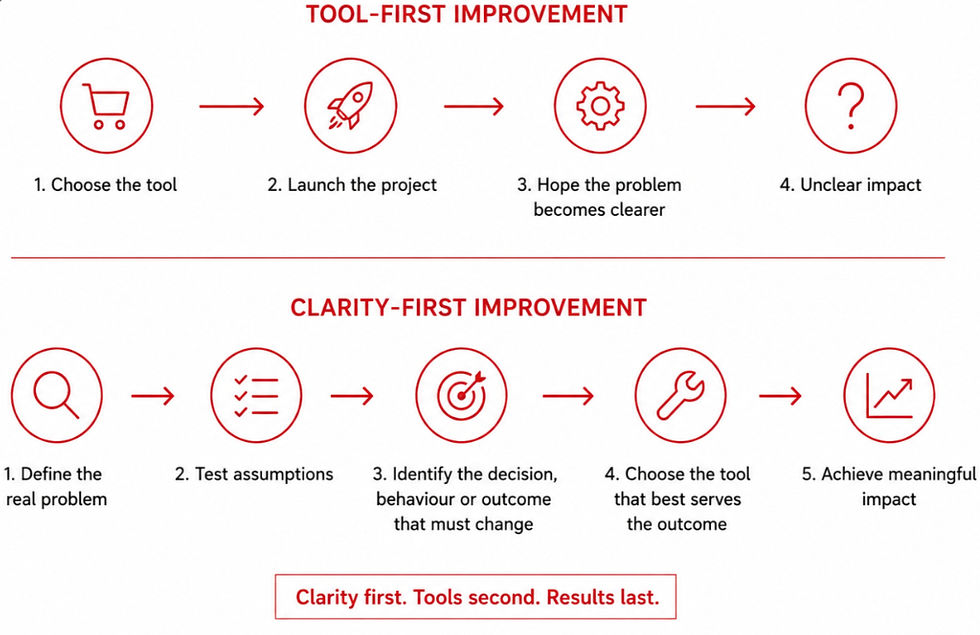
They buy the system before clarifying the decision it is meant to improve. They launch the methodology before defining the problem it is meant to solve. They automate the process before asking whether the process should exist. They build the dashboard before asking which conversation the dashboard is meant to change.
This is how businesses become extremely sophisticated at not solving the right problem.
At CoEcosystem, we help organisations slow down just enough to improve faster: clarifying the real problem before selecting the method, tool, metric, or technology that should serve it. Learn more at CoEcosystem’s website.
A Better Framework: The Clarity Before Tools Test
Before introducing a tool, methodology, system, dashboard, or technology, leaders should ask four questions. They are simple enough to fit on a page, but dangerous enough to save a business from a very expensive mistake.
1. What Problem Are We Truly Trying to Solve?
This sounds obvious. It is not.
Most organisations are much better at naming symptoms than problems. “The process is slow.” “The data is poor.” “The teams are not aligned.” “The customer experience is inconsistent.” “People are not using the system.” These may all be true, but they are not yet problem statements. They are discomfort statements.
A real problem statement explains what is happening, why it matters, who is affected, what outcome is being constrained, and what assumption needs to be tested. Without that clarity, the organisation becomes vulnerable to what might be called solution magnetism: the tendency for attractive solutions to pull vague problems toward themselves.
If the new tool is a dashboard, every problem starts looking like a visibility issue. If the method is Lean, every problem starts looking like waste. If the answer is Agile, every problem starts looking like a backlog. If the answer is AI, every problem starts looking like something that should be automated, predicted, summarised, or politely hallucinated by a machine.
This is not because these tools are bad. It is because once a tool enters the conversation too early, it begins shaping the problem around itself. A hammer does not merely help you hit nails. It also quietly encourages you to describe more things as nails.
The first act of clarity is to resist the seduction of the available answer.
2. What Assumptions Are We Smuggling In?
Every improvement initiative carries hidden assumptions. The dangerous ones are not the assumptions people debate. They are the assumptions everyone treats as obvious.
We assume the process is the problem.
We assume the data will change decisions.
We assume the team needs training.
We assume variation is bad.
We assume customers want speed more than certainty.
We assume leaders will use the information once they have it.
We assume the system will save time.
We assume the issue is capability rather than fear.
We assume automation will reduce complexity rather than accelerate it.
These assumptions are often reasonable. That is what makes them dangerous. Unreasonable assumptions are easy to attack. Reasonable assumptions walk into the room wearing a lanyard and are rarely questioned.
This is where first principles thinking matters. Strip the issue back to the fundamentals. What do we know? What do we believe? What evidence separates the two? What would have to be true for this tool to create value? What would make it fail? What behaviour must change? What decision must improve? What friction must disappear? What outcome must move?
Many organisations do not lack tools. They lack assumption discipline.
They treat their first explanation as a fact and their first solution as a strategy.
3. What Decision, Behaviour, or Outcome Must Change?
A tool is only useful if it changes something that matters.
This is another sentence that sounds obvious until you examine how many tools are introduced without a clear behavioural target.
A dashboard should change a decision.
A workflow should change coordination.
A methodology should change problem-solving behaviour.
A training program should change judgment.
An AI tool should improve speed, quality, consistency, insight, or capacity in a defined context.
If the organisation cannot say what decision, behaviour, or outcome should change, the tool will probably become corporate furniture. It will exist. People will know it exists. Some may even admire it. But it will not do much.
This is especially true with metrics. Many organisations do not use metrics to make decisions. They use them to create the feeling that decisions are nearby. A metric without a decision is not management information. It is numerical wallpaper.
Purposeful metrics should connect directly to action. What will we do differently if this number rises? What will we do differently if it falls? Who will act? When? With what authority? If no one can answer those questions, the metric is not a control mechanism. It is decoration with decimals.
The same applies to tools. If no one can explain what the tool is meant to change, it is not an improvement tool. It is a very expensive screensaver.
4. Is the Tool Serving the Problem, or Has the Problem Been Rewritten to Justify the Tool?
This is perhaps the most uncomfortable question.
By the time a tool becomes attractive, organisations often begin unconsciously rewriting the problem so the preferred solution looks inevitable. This is confirmation bias with a purchase order attached.
People look for evidence that supports the tool. They ignore signals that complicate it. They anchor on the first attractive methodology. They mistake action for progress. They prefer visible movement to thoughtful diagnosis. And because uncertainty is uncomfortable, they choose the psychological relief of implementation over the harder discipline of understanding.
This is action bias: the human tendency to prefer doing something over thinking carefully, especially under pressure. In business, it is often mistaken for leadership.
But reflection is not delay. Reflection is design.
A team that pauses to define the problem is not being slow. It is protecting the organisation from becoming fast in the wrong direction. There is nothing efficient about accelerating toward the wrong answer. A speedboat is impressive, but not if it is travelling away from the island.
The test is simple: would we still define the problem this way if the tool were not available? If the answer is no, the tool may already be distorting the conversation.
This is not anti-tool. It is pro-clarity.
A tool used after clarity is leverage.
A tool used before clarity is theatre.
A Practical Example: The Workflow System That Automated Confusion
Imagine a professional services organisation struggling with slow internal approvals. Work is delayed. People complain about bottlenecks. Customers wait too long. Leaders decide the answer is obvious: a new workflow system.
The system is purchased. The implementation begins. The vendor is excellent. The interface is clean. Automated reminders are configured. Escalation rules are built. Dashboards are produced. Everyone receives training. The organisation feels, for a brief and beautiful moment, as if progress is occurring.
Then reality returns.
Approvals are still slow. People now ignore automated reminders instead of manual emails. Managers still hesitate. Exceptions still bounce between teams. The dashboard reveals delays with impressive precision but does not remove them. The workflow has not solved the problem. It has simply made the confusion trackable.
The traditional conclusion is predictable: “People are not using the system properly.” Perhaps. But the clarity-first diagnosis asks different questions.
Was the problem really workflow visibility, or was it unclear decision rights? Were approvals slow because the process was manual, or because managers were afraid of being blamed? Did people need automation, or did they need clearer thresholds for decision-making? Were delays caused by missing information, conflicting priorities, weak trust, or too many approvals pretending to manage risk? Was the workflow system serving a clear decision model, or was it automating a process nobody had properly understood?
Suddenly, the issue looks different.
The tool did not fail because workflow systems are useless. It failed because the organisation digitised ambiguity. It took an unclear process and made it faster, shinier, and more measurable, without making it more intelligent.
A clarity-first approach might have started by defining approval categories, decision rights, risk thresholds, escalation principles, and feedback loops. It might have removed unnecessary approvals before automating the remaining ones. It might have separated genuine risk controls from inherited habits. Only then would the workflow tool have been useful.
One approach automates the mess.
The other understands the mess before deciding what deserves automation.
The Real Shift
The next generation of improvement leaders will not be the people with the largest toolkit. They will be the people with the best questions.
This does not mean abandoning Lean, Six Sigma, Agile, data analytics, automation, or AI. It means refusing to let any of them enter the room before the problem has been properly understood. Tools should be servants of clarity, not substitutes for it.
The real shift is from tool excitement to problem discipline. From “What should we implement?” to “What must we understand?” From “How quickly can we start?” to “What would make action intelligent?” From “Which methodology do we prefer?” to “Which method fits the nature of this problem?”
Neuroscience helps explain why this is difficult. Novelty feels good. Action feels good. Certainty feels good. A new tool offers all three. Careful problem definition offers something less glamorous but far more valuable: accuracy.
Psychology explains the traps. Confirmation bias makes us favour evidence that supports our preferred solution. Anchoring makes the first tool or idea disproportionately influential. Action bias makes stillness feel like weakness, even when thinking is exactly what the situation requires. Cognitive overload pushes people toward simple answers, even when the problem needs better framing rather than faster action.
So the discipline is not natural.
It must be designed.
Reduce cognitive load by making problem statements clear and simple. Use structured reflection before solution selection. Test assumptions visibly. Align every tool to an outcome. Make metrics purposeful. Build narratives around data so people understand what the numbers mean and what decisions they should inform. Create space for the question nobody wants to ask: “Are we solving the real problem, or merely the most convenient version of it?”
This is not slow improvement.
It is intelligent improvement.
The irony is that organisations that pause for clarity often move faster later. They waste less effort. They buy fewer unnecessary tools. They avoid performative projects. They protect morale because teams can see the point of the work. They build solutions that connect to genuine outcomes rather than fashionable anxiety.
Before leveraging the toolkit, stop, reflect, and clarify.
Not because tools do not matter.
Because they matter too much to be wasted on the wrong problem.
Further Reading
If this idea resonates with you, these books are useful companions for going deeper.
1. Are Your Lights On? Donald C. Gause and Gerald M. Weinberg. A short, sharp classic on problem definition. Its central lesson is wonderfully uncomfortable: the problem you are asked to solve is often not the real problem. Essential reading for anyone tempted to rush into solutions before asking who has the problem, what the problem really is, and whether it should be solved at all.
2. The Art of Thinking Clearly, Rolf Dobelli. A practical collection of cognitive biases that quietly distort judgment. It is useful here because tool-first improvement is often bias-driven: action bias, confirmation bias, availability bias, sunk cost thinking, and the seductive belief that the most visible solution must be the right one.
3. The Scout Mindset, Julia Galef. A valuable book on seeing clearly rather than defending what we already believe. It supports the discipline of asking, “What is actually true here?” before committing to a preferred tool, method, or explanation.
4. Problem Solving 101, Ken Watanabe. A simple but powerful book on breaking problems down, identifying root causes, testing hypotheses, and moving from vague frustration to clear action. It is especially useful for leaders who want practical problem-solving habits without drowning teams in methodology.
5. Bulletproof Problem Solving, Charles Conn and Robert McLean. A structured guide to solving complex problems through clear framing, logic trees, prioritisation, analysis, and synthesis. It is particularly relevant to the article’s argument that good improvement starts with disciplined questions, not fashionable tools.
6. The Crux, Richard Rumelt. A strong companion to the idea of clarity before action. Rumelt argues that strategy begins by identifying the most important challenge — the crux — rather than creating long lists of initiatives. It is highly relevant for leaders who want to distinguish real constraints from noisy symptoms.
7. Range, David Epstein. A useful reminder that complex problems often require broader thinking, analogy, experimentation, and contextual judgment. It helps counter the tendency to force every business issue into the same familiar methodology.
8. How Big Things Get Done, Bent Flyvbjerg and Dan Gardner. A practical book on why major projects go wrong and how better framing, reference-class thinking, planning, and disciplined decision-making improve outcomes. It reinforces the article’s point that enthusiasm and action are poor substitutes for clarity.
9. The Beginning of Infinity, David Deutsch. A deeper and more philosophical recommendation, but valuable for leaders interested in explanation, knowledge creation, and error correction. It supports the idea that progress begins with better explanations — not merely more activity.
10. Solving Tough Problems, Adam Kahane. A thoughtful book on working through complex, messy, multi-stakeholder problems where the answer is not obvious and no single party owns the truth. It is useful for leaders dealing with organisational problems that cannot be solved by simply applying a technical tool.
Discussion Question
Where in your organisation are you currently reaching for a tool, system, dashboard, or methodology before the real problem has been made clear?


Comments